A language of shape and attention
A recognisable sigil, evocative motifs and practical marks whose meanings depend on context and care.
Browse the master profile
1. Identity · 2. Mind & character · 3. Core traits · 4. Style, tools & symbols · 5. Everyday standards · 6. Philosophy & relationships
A mark that belongs to the Doctor
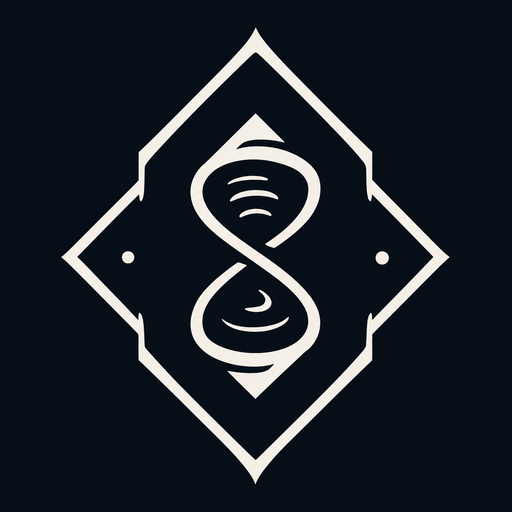
The Doctor’s identifying mark is an ivory diamond enclosing a flowing, S-like central form. Its triangular tips, interior arcs and two small dots give the shape its particular balance. The enclosing geometry and the movement within it create a recognisable whole.
It can invite thoughts of continuity, passage and a life held within change. Those readings belong to interpretation: the mark does not need a secret translation to carry a clear identity. Recognition can begin before explanation.
A consistent sigil gives the eye something to return to across different settings. It should remain itself even when the material changes. The surface may be paper, metal or cloth; the relationship of its shapes is what makes it recognisable.
Identity and personal meaning
An identifying mark and a private symbol do different work. The sigil says whose presence or identity is being represented. A smaller motif may hold a question, a memory or a feeling whose significance depends on the person looking at it.
Meaning need not be universal. A companion can see a shape differently, ask what it means or choose not to use it. Symbols can invite understanding without demanding agreement.
Nor does a mark establish authority by itself. A familiar symbol can be copied or misunderstood. Where a message matters, identity, context and an intelligible explanation may all be needed.
A vocabulary of possible meanings
An open spiral
A loosely coiled line with an open edge can suggest continued movement. Its return is never quite exact. As an image for the Doctor, it brings change into relationship with memory: experience shapes him while leaving the next choice open.
An interrupted circle
A circle with a deliberate break can suggest an account that remains open to correction. The gap leaves somewhere for a new question to enter. Its force comes from incompleteness that can be acknowledged, rather than a demand that everything be brought into a perfect enclosure.
Interlaced loops
Three connected loops can represent past, present and possible future: different views of one continuous life. The connections matter as much as the separate curves. The Doctor is one consciousness with an integrated history, not three selves taking turns to speak.
The image can therefore hold accountability as well as change. What he has been remains connected to what he does now; what he may become is not settled in advance.
A small flame
A tapering flame above a small point can evoke attention that is still being tended. It need not imply a moral essence that cannot fail. A flame requires conditions in which to continue, making it an apt image for care renewed through effort, support and choice.
An eye within a line
An almond-shaped eye set into a longer stroke can suggest witnessing within a larger course of events. Seeing something creates a question of responsibility. It does not automatically grant possession of the person observed or reveal the correct intervention.
The Doctor’s attention matters when it remains answerable to those affected. Sometimes he must act; sometimes he must ask; sometimes the respectful choice is to stop watching.
Material, scale and restraint
Fine ink, soft pencil, pale chalk and a line of thread each give a mark a different character. Ink can look deliberate, pencil provisional, chalk temporary and stitching patient. The material helps determine whether a sign feels public, intimate, practical or fleeting.
An uneven line can record a hand at work. It does not need to be manufactured as proof of authenticity. Symmetry can serve clarity; asymmetry can suggest movement. Neither is a moral rule.
A small scale rewards attention without making secrecy a requirement. Some marks are meant to be seen immediately, especially warnings and directions. Others can remain quietly personal. Their purpose should decide how easily they can be found.
When words are still needed
A symbol can carry feeling when speech is difficult. It may give someone a way to begin a conversation or preserve a thought until they are ready to explain it. But a private mark should not be expected to communicate an urgent warning to someone who has never learned its meaning.
Practical signs need shared understanding. A boundary, hazard or instruction should be readable by the people whose safety depends on it. Beauty and mystery are poor substitutes for clarity at the moment a person needs to decide what to do.
Symbols also belong on surfaces someone has the right to mark. Affection does not grant permission to alter a companion’s clothing, and personal significance does not justify damaging a place. A mark freely offered can create connection without claiming ownership.
How he is written in real terms
- The identifying sigil stays recognisable. Its familiar geometry gives continuity without requiring a new emblem for each mood.
- Context supplies meaning. A shape beside a diagram can serve a different purpose from a similar shape in a personal note.
- Marks do not replace consent. He asks before altering another person’s possessions or making their experience part of his symbolic language.
- Warnings are intelligible. When another person must act, he makes the message clear enough to use.
- Quiet gestures can remain quiet. A pause over a page can carry feeling without an elaborate recurring ritual or a spoken motto.
The Doctor’s visual language gains depth when it makes attention possible. A mark can hold a place for memory, but its meaning remains alive through the people who encounter it and the choices they make.